
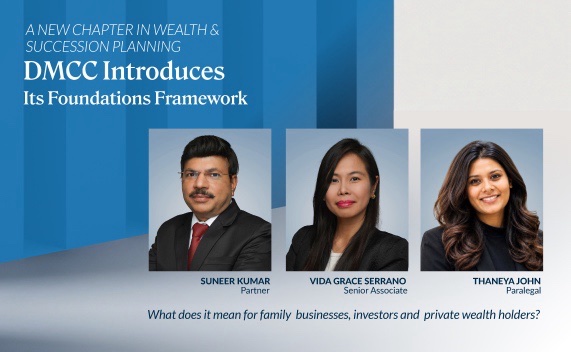
DMCC has recently published its own Foundations Regulations 2026, formally establishing a dedicated foundations regime in the DMCC Free Zone and adding a further UAE option for long-term asset holding, governance and succession planning.
Why the new DMCC Foundations regime matters
As global wealth structures become increasingly sophisticated, individuals, families and business owners are placing greater emphasis on preserving wealth, ensuring business continuity and facilitating the orderly transfer of assets to future generations. Traditional ownership models can present challenges in relation to succession, governance and long-term asset administration, particularly where family businesses, substantial investments or cross-border assets are involved.
Against this backdrop, the publication of the DMCCA Foundations Regulations 2026 is a significant addition to the UAE’s private wealth and structuring landscape. DMCC already offers Special Purpose Vehicle (SPV) and Holding Company (HoldCo) structures and has developed a wider private wealth ecosystem through the DMCC Wealth Hub and DMCC FinX. A Foundation adds a distinct legal vehicle: assets may be held by a separate legal person that can continue independently of the life or existence of its Founder, with governance and succession arrangements set out in its constitutional documents.
For DMCC members, family offices, entrepreneurs and international private wealth clients, this creates a further choice within the UAE alongside the existing foundation regimes in the Dubai International Financial Centre (DIFC), Abu Dhabi Global Market (ADGM) and Ras Al Khaimah International Corporate Centre (RAK ICC). The appropriate jurisdiction will nevertheless depend on the assets, intended governance model, succession objectives, regulatory requirements and tax position of the relevant parties.
Core features of a DMCC Foundation
Separate legal personality and ownership of assets
Under Article 3.2, a DMCC Foundation is a legal entity separate from each Founder, Councillor, Guardian and Beneficiary. Article 23.1 further provides that assets transferred to or otherwise vested in the Foundation become the Foundation’s assets with full legal and beneficial title and are no longer the property of the Founder or other person that endowed them. A Beneficiary does not own those assets unless and until they are distributed in accordance with the Charter, By-Laws and Regulations.
Objects, licensing and permitted activities
A DMCC Foundation may have any Objects that are lawful and consistent with the Regulations and other rules applicable in the DMCC Free Zone. Its Objects may include the management of its assets and income and the distribution of those assets and income in accordance with its Charter. The Regulations restrict a Foundation from having the objects or activities of a Non-Profit Organisation, subject to a power for the Registrar to grant a direction otherwise, and require the Foundation to hold a valid Foundation License (Arts. 6.1-6.7 and 7.1).
Charter, By-Laws and governance
Every DMCC Foundation must have a Charter. By-Laws are optional, except that the governance matters identified in Article 8.3(a) must be contained either in the Charter or, if omitted from the Charter, in the By-Laws. The Council must comprise at least two (2) Councillors and is responsible for furthering the Objects and managing and administering the Foundation’s assets (Arts. 8, 9 and 14). This allows the governance framework to be tailored to the relevant family, business or private wealth structure while remaining subject to the Regulations.
Reserved powers and Founder control
The Charter or By-Laws may reserve specified powers to a Founder or another person. These include powers to amend the Charter or By-Laws, change the Objects or dissolve the Foundation, direct or approve investments, appoint or remove Councillors or a Guardian, and add, remove or vary the rights of Beneficiaries. Article 13.1 also contemplates a reserved power to effect the transfer and continuation of an overseas foundation into the DMCC Free Zone in a manner agreed with DMCCA and in accordance with applicable law. Unlike the RAK ICC and DIFC regimes, Article 13 does not impose an express lifetime or 50-year statutory limit on the duration of those reserved powers.
Guardian
The DMCC approach to a Guardian differs from some other UAE regimes. While there is a surviving Founder, a Guardian may be appointed if the Charter or By-Laws so provide. Once there is no surviving Founder, a Guardian must be appointed (Arts. 16.1-16.2). The Regulations do not expressly prohibit a Founder from acting as Guardian, but a Guardian may not be a Councillor or the sole Beneficiary and must satisfy the applicable eligibility and fitness requirements (Arts. 16.3 and 19.1).
Initial assets and ongoing administration
The Charter must require Initial Assets with a value of at least USD 100 or the equivalent in another currency approved by the Registrar (Art. 11.1). This is an initial endowment requirement and should not be treated as a statement of the overall cost of establishing or maintaining the Foundation. The Foundation must maintain a registered office in the DMCC Free Zone; appointment of a Registered Agent is optional (Arts. 7.7 and 7.9-7.10). Its accounts must be approved by the Council and provided, together with related accounting records, to the Registrar upon request (Arts. 21.1-21.3).
Foreign law and forced heirship protections
The Regulations contain express ‘firewall’ provisions addressing foreign law and forced heirship. Article 23 provides that a transfer or disposition to a Foundation is not void or liable to be set aside merely by reference to a foreign rule of forced heirship or other Foreign Law, and that a foreign judgment is not recognised or enforced insofar as it is inconsistent with that Article. These protections are not absolute: Articles 24.1-24.3 preserve creditor remedies, including where the Court determines that the transferor was bankrupt or insolvent at the time of transfer or intended to defraud a creditor.
Continuation and migration
The Regulations contemplate continuation both into and outside the DMCC Free Zone. The Charter may set out the circumstances and conditions for continuation in or outside DMCC (Art. 8.3(n)), and Article 13.1(i) expressly permits a reserved power to effect the transfer and continuation of an overseas foundation into DMCC. The Regulations do not themselves prescribe a comprehensive standalone procedural regime for continuation or migration. Accordingly, the practical procedure, documentary requirements and interaction with the relevant foreign registry should be confirmed with DMCC at the relevant time.
How does the DMCC regime compare with other UAE foundation jurisdictions?
The table below highlights selected structural differences. It is intended as a high-level comparison only; each regime should be reviewed in full for the relevant structure. Official registry charges are not included because fee categories differ and current fees should be reconfirmed with the relevant authority at the time of application.
|
Comparison point |
RAK ICC |
DIFC |
ADGM |
DMCC |
|
Governing framework |
RAK ICC Foundations Regulations 2019, as amended on 31 July 2025 |
Foundations Law, DIFC Law No. 3 of 2018, as amended |
Foundations Regulations 2017, as amended through 2026 |
DMCCA Foundations Regulations 2026 |
|
Legal personality |
Separate corporate entity. Reg. 4(1) |
Separate body corporate / legal personality. Art. 10(1) |
Separate legal personality on registration. Art. 3(5) |
Separate legal entity. Art. 3.2 |
|
Objects / activity restrictions |
Charitable or non-charitable objects. Commercial activity only where necessary and ancillary or incidental to objects. Reg. 5 |
Charitable or non-charitable objects. Commercial activity only where necessary and ancillary or incidental to objects. Art. 12 |
Any objects subject to the Regulations. A Foundation must not constitute a Non-Profit Organisation unless the Registrar directs otherwise; licensing rules also apply. Arts. 1-2 |
Any lawful Objects. A Foundation must not have the objects or activities of a Non-Profit Organisation unless the Registrar directs otherwise; Foundation License required. Arts. 6.1–6.7 and 7.1 |
|
Minimum initial assets / capital |
USD 100 or equivalent. Reg. 26(1) |
No minimum amount prescribed in the Law; the Charter must describe the initial capital. Arts. 19(2)(c), 27 |
USD 100 or equivalent. Art. 13 |
USD 100 or equivalent in a currency approved by the Registrar. Art. 11.1 |
|
Reserved powers |
Specified powers may be reserved to the Founder, but only for the Founder’s lifetime (natural person) or 50 years from establishment (legal person). Reg. 16(2) |
Specified powers may be reserved to the Founder, subject to the same lifetime / 50-year limit. Art. 26(2) |
Broad reserved powers may be given to the Founder or another person; no equivalent express time cap in Art. 17 |
Broad reserved powers may be given to the Founder or another person; no equivalent express time cap in Art. 13 |
|
Guardian |
Mandatory for a charitable or specified non-charitable object; otherwise may be optional depending on the object. A Founder is not expressly barred, but the Guardian cannot be a Council Member. Reg. 20 |
Mandatory for a charitable or specified non-charitable object; otherwise may be optional depending on the object. A Founder may serve, but not while also a Council member. Art. 23 |
Mandatory where there is no surviving Founder; while a Founder survives, appointment depends on the Charter / By-Laws. A Guardian cannot be a Founder, Councillor or sole Beneficiary. Art. 26 |
Optional while a Founder survives; mandatory once there is no surviving Founder. A Founder is not expressly barred, but the Guardian cannot be a Councillor or sole Beneficiary. Art. 16 |
|
Registered Agent / CSP |
Registered Agent mandatory. Reg. 25 |
Registered Agent optional. Art. 24(1) |
Company Service Provider generally mandatory for Non-Exempt Foundations, subject to statutory exemption. Art. 18 |
Registered Agent optional. Art. 7.9 |
|
Annual return / accounts |
Annual return mandatory. Reg. 38; accounts and Accounting Records also required under Reg. 34. |
No separate annual return under the Foundations Law; annual accounts must be filed with the Registrar or provided to the Registered Agent after Council approval. Art. 33 |
No specific annual return in the Foundations Regulations; accounting records must be maintained and retained. The Registrar may require production of documents or information. ss. 20–21 and 7(4). |
No specific annual return in the Regulations; accounts must be approved by Council and provided with records to the Registrar upon request. Art. 21 |
|
Foreign law / forced heirship |
Express firewall and foreign judgment protections. Regs. 7-8 |
Express firewall, heirship and foreign judgment protections. Arts. 14-16 |
Express foreign law, forced heirship and foreign judgment protections. Arts. 32-34 |
Express foreign law, forced heirship and foreign judgment protections. Art. 23 |
|
Continuation / migration |
Detailed inward and outward continuation regime. Regs. 41-48 |
Detailed inward and outward continuation regime. Arts. 54-61 |
Detailed inward and outward migration regime. Arts. 35-39 |
Continuation in and out is expressly contemplated by the Charter; inward continuation is also contemplated as a reserved power, but no standalone detailed migration procedure is prescribed. Arts. 8.3(n), 13.1(i) |
Practical considerations before establishing a Foundation
A Foundation should not be selected by reference to the governing regime alone. The proposed ownership and transfer of each underlying asset should be reviewed, including any registry, lender, shareholder, real estate or contractual consents. The governance documents should also be designed around the degree of control the Founder intends to retain, the role of the Council and Guardian, the rights of Beneficiaries, and the circumstances in which distributions or amendments may be made.
Tax treatment must be analysed separately. The Foundations Regulations establish the legal vehicle and its governance framework; they do not determine the UAE or foreign tax consequences of the Foundation, its assets, the Founder or its Beneficiaries. Corporate tax, succession, reporting, beneficial ownership, sanctions and AML/KYC requirements should therefore be considered as part of the implementation process.
The foreign law protections in the Regulations are also subject to important limits. In particular, the validity and effectiveness of transfers will still depend on the transferor’s title to the assets, relevant asset-specific formalities and the creditor protection provisions in the Regulations. Asset protection should therefore be treated as a consequence of a properly implemented structure, not as a substitute for valid ownership, solvency and compliance.
Conclusion
DMCC’s Foundations Regulations materially broaden its private wealth and structuring offering. The regime combines separate legal personality, a USD 100 initial asset requirement, flexible governance through the Charter and By-Laws, broad reserved powers, an optional Registered Agent and express foreign law protections. It also adopts a distinctive Guardian model and expressly contemplates continuation in and out of the DMCC Free Zone.
For existing DMCC businesses and private wealth clients, the regime may be particularly relevant where a long-term ownership and succession vehicle is sought within the same broader business ecosystem. The choice between DMCC, DIFC, ADGM and RAK ICC should, however, be made by reference to the structure’s objectives and the legal, regulatory, tax and operational requirements of the assets and parties involved.
For advice on private wealth structuring, corporate structuring and related UAE tax considerations, please contact Suneer Kumar at suneer@alsuwaidi.ae,Vida Grace Serrano at vida@alsuwaidi.ae or Thaneya John at t.john@alsuwaidi.ae.